
How Much Rainwater Are You Wasting at Your Brisbane Property?
How much rainwater could your Brisbane roof collect?
Every time it rains, your roof becomes a rainwater catchment area. If you do not have enough storage capacity available, much of that water simply continues into the stormwater system rather than being stored for later use around your property.
The basic rainwater harvesting calculation is quite simple: 1 millimetre of rain falling on 1 square metre of roof represents approximately 1 litre of potential rainwater catchment.
For example, if a Brisbane property has 150 m² of usable roof catchment and receives 25 mm of rain:
150 m² × 25 mm = 3,750 litres
That’s approximately 3,750 litres of potential rainwater catchment from a single rainfall event, before allowing for first-flush diversion, runoff losses, tank overflow and other real-world factors.
The question is therefore not simply how much rain falls on your Brisbane property. It is also how much of that rainwater you have the capacity to collect, store and use before the next substantial rainfall event.
Where could that stored rainwater be used?
Water use around a home can add up quickly. The actual amount used will vary between households, appliances and individual habits, but some typical examples include:
- Garden sprinkler: approximately 15 litres per minute.
- Hosing outdoor surfaces: approximately 15 litres per minute.
- Toilet: approximately 6 litres for a full flush or 3 litres for a half flush.
- Front-load washing machine: approximately 80 litres per load.
- Top-load washing machine: approximately 100 litres per load.
- Car washing: approximately 200 litres per wash.
- Swimming pool top-up: varies considerably depending on the pool and the amount of water required.
This is why rainwater storage is a balance between supply, storage and demand. A property might have excellent roof catchment, but if the tank fills quickly and then overflows, additional rainfall cannot be stored until some of the existing water has been used.
Is your existing rainwater tank large enough?
A small tank can still be very useful, particularly where space is restricted. However, where a property has good roof catchment and regular water demand, increasing storage capacity may allow more rainfall to be retained rather than lost through the overflow.
Three important factors should be considered when choosing a rainwater tank:
- Space available – the actual maximum length, width and height available for the tank.
- Rainwater supply – the roof catchment area and rainfall available to fill the tank.
- Water demand – how much stored rainwater you are likely to use between rainfall events.
Our Rainwater Catchment Calculator can help you compare your roof catchment with your estimated water usage and get a better idea of the storage capacity that may be useful at your property.
Choosing a water tank for a Brisbane property
The amount of rainwater you could potentially collect is only part of the decision. The available space on your property will usually determine which tank designs and capacities can physically be considered.
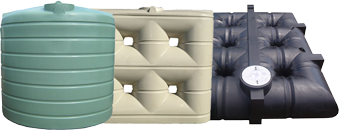
Round rainwater tanks
Where sufficient space is available, a round poly water tank generally provides excellent storage capacity for the available spend and is available in a wide range of sizes.
Slimline rainwater tanks
For Brisbane homes with narrower side access or restricted yard space, a slimline water tank may provide a practical way of storing rainwater while using less width than many conventional round tanks.
Underground and underdeck tanks
Where usable above-ground space is particularly limited, underground water tanks or other purpose-designed space-saving options may also be worth considering.
Actual site measurements are important when selecting any tank. Product dimensions should always be compared against the maximum available length, width and height at your property, together with appropriate installation and maintenance clearances.
How much rainwater are you currently letting go?
If your roof receives thousands of litres of potential catchment during a rainfall event but your available tank storage is already full, the excess water has nowhere to be stored.
That does not automatically mean that the biggest possible tank is the right choice. A useful rainwater harvesting system is one that sensibly balances the water your roof can supply, the water your household or property can use and the physical space available for storage.
If you want to put some actual numbers against your property, start with our Rainwater Catchment Calculator. You can then compare suitable tank designs and capacities within our complete water tank range.
Our original “How Much Rainwater Are You Wasting?” infographic
The infographic below provides a visual overview of the same basic principle: everyday water consumption can be substantial, while rainfall falling onto your roof represents a potential water resource that can be collected and stored for later use.

Rainwater tanks delivered to Brisbane
The Tank Factory is the online sales division of Duraplas Industries. We supply Australian-made Duraplas poly rainwater tanks direct to customers, together with Kingspan Aquaplate steel water tank options.
Our range includes round, slimline, underground and other water storage options suitable for many different property types. For Brisbane-specific product and delivery information, visit our Water Tanks Brisbane QLD page.
Our friendly team look forward to assisting with your water tank purchase.
Related pages:
Water Tanks Brisbane QLD |
Water Tanks Brisbane Northside |
Water Tanks Ipswich |
Rainwater Catchment Calculator
Contact Our Friendly Staff
Our experienced staff look forward to
assisting with your enquiry
Read Our FAQs
Watch Our Video
How our Tanks Compare
Fun Facts About The Tank Factory
Browse Our Tank Range
We Accept:

OUR MOST POPULAR TANK RANGES

Round Water Tanks
Amazing Value Tanks. Up to 34,000L

Slimline Water Tanks
Great for tight spaces. Up to 5,000L

Underground Tanks
Totally out of sight. Up to 5,000L
